
Product Description
Why Choose Us
With years of deep expertise in the clean laboratory protective equipment sector, we supply a complete range of units, including class i biosafety cabinet and class ii biological safety cabinet systems, alongside original hepa filter for biosafety cabinet consumables. We are intimately familiar with laboratory construction standards across the Middle East, Southeast Asia, and Europe, supporting parameter customization in accordance with local regulations.
Each unit is built with thickened cold-rolled steel and a seamlessly molded stainless steel work zone. Strictly following international biosafety standards, every bsc cabinet undergoes rigorous factory acceptance testing—including airflow, negative pressure, and filter integrity checks—to guarantee long-term, stable operation.

We offer one-stop comprehensive service: assisting clients during early-stage planning, providing technical Q&A to clearly explain what is a biological safety cabinet, and delivering a complete package of English certificates and test reports with every shipment. For overseas projects, we provide remote technical guidance and can coordinate local engineers for on-site installation, commissioning, and routine maintenance. Supported by a stable supply chain that guarantees delivery times and eliminates project delay risks, we are your reliable long-term partner for laboratory, pharmaceutical, and bioresearch projects.
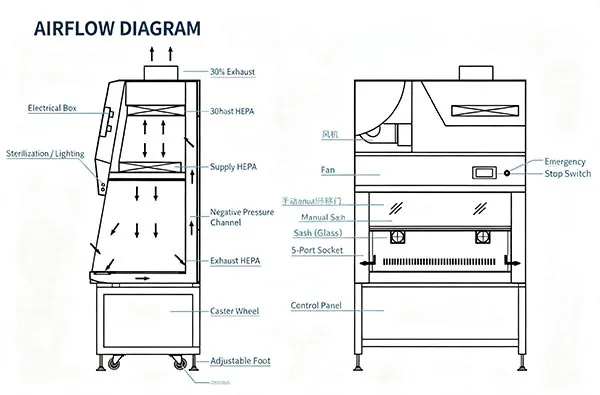
what is a biological safety cabinet? A biological safety cabinet (bsc cabinet) is specialized containment equipment compliant with biosafety levels that integrates directional airflow control, high-efficiency filtration, and a negative pressure chamber. The market primarily features two major categories: the class i biosafety cabinet and the class ii biological safety cabinet. The system relies on a hepa filter for biosafety cabinet to achieve core purification. Utilizing aerodynamics to create a dynamic barrier across the work zone, it coordinates vertical laminar airflow with inward inflow air to deliver tiered protection for personnel, samples, and the surrounding environment. It captures and filters bio-aerosols, recirculating or exhausting hazardous substances safely.

Product Features
Negative Pressure Laminar Flow: Inward directional airflow maintains a negative pressure work area to prevent microbial escape, safeguarding both personnel and the environment.
Durable & Easy to Clean: Constructed with a powder-coated cold-rolled steel exterior and a seamless stainless steel work area. Washable interior surfaces feature large R15 rounded corners to eliminate cleaning dead spots.
Comprehensive Safety Protection: Equipped with audible and visual alarms if the glass sash exceeds safe height limits. Dual hepa filter for biosafety cabinet configurations for both supply and exhaust air serve as a standard protective structure for a class ii biological safety cabinet.
Intelligent Control: Features an LCD screen displaying real-time airflow velocities and adjustable parameters. Offers three-tier user permissions with password protection to prevent unauthorized operation.
Working Principle
A biological safety cabinet relies on directional airflow and a hepa filter for biosafety cabinet to block external contamination while filtering out hazardous particles generated during operations, thereby protecting the operator, sample, and environment. Whether it is a class i biosafety cabinet or a class ii biological safety cabinet, both depend on this airflow filtration system to establish a safe isolation barrier—which represents the core technical logic when exploring what is a biological safety cabinet.
Applications
Biological safety cabinets (bsc cabinet) are designed for handling pathogenic microorganisms, biologically active materials, and other hazardous experimental procedures, protecting personnel, samples, and the environment from contamination or infection. The most widely used model in laboratory settings is the class ii biological safety cabinet, which, when paired with a professional hepa filter for biosafety cabinet, fulfills the routine testing requirements of the vast majority of biological laboratories.
FAQ
Q1: What is the difference between Class II A2 and Class II B2 biological safety cabinet?
A: Class II A2 model adopts 30% exhaust and 70% internal circulation, suitable for low-risk biological experiments, cost-effective and low energy consumption.
Class II B2 is 100% full exhaust, all polluted air is discharged outside after HEPA filtration. It is ideal for operations with toxic reagents, volatile chemicals and high-risk pathogens.
Q2: Can you supply compatible hepa filter for biosafety cabinet as spare parts after delivery?
A: Yes. We provide original matching HEPA filters for all our bsc cabinet. We maintain stable spare parts inventory, support separate sales and global delivery. We can also guide your technicians to complete filter replacement.
Q3: Is this Class II biological safety cabinet suitable for laboratories in Southeast Asia, Middle East and European markets? Can we customize power supply?
A: Our standard unit is 220V 50Hz. We support customized power parameters (110V/60Hz etc.) to meet different regional standards. All units comply with international biosafety requirements, widely used in pharmaceutical, biological labs across Europe, Southeast Asia and the Middle East. Every machine will pass complete airflow and filter testing before shipment, and we can provide full set of test documents.
Factory Environment
|
CIDAN CNC Folding Machine |
CIDAN CNC Folding Machine |
Fully Automatic CNC Laser Cutting Machine |
|
Fully Automatic Sealing Gluing Equipment |
Intelligent Flexible Bending Center |
Intelligent Production Line for HEPA Filters |


Case Studies
|
Aerospace Cleanroom Engineering |
Cosmetics Industry Cleanroom Projects |
Electronics Industry Cleanroom Projects |
|
Healthcare Industry Cleanroom Projects |
Pharmaceutical and Biotechnology Industry Projects |
Food Industry Cleanroom Projects |